Article Song

Turn any article into a song.

A Firefox add-on. Open an article, pick a style, press Create. About three minutes later, the article is being sung back to you, with lyrics written from what it actually says.

Firefox · version 1.2 · open source (MIT) · needs a SunoAPI key, a few cents a song

Listen

Real songs, straight from the add-on

Each song was made with Article Song's recipe from the page linked under its title. The lyrics and audio are exactly what came out; nothing was edited.

From Wikipedia, one style each

Same recipe, different instructions to the lyricist.

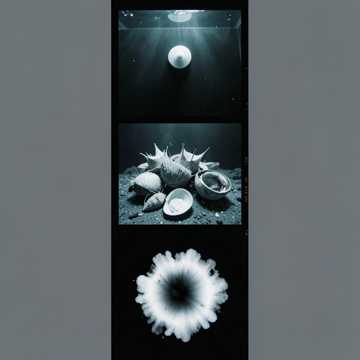
Octopus

Musical Wikipedia · 3:40

Patter-Song Musical Theatre, Whimsical Bravado, Bittersweet Bridge, Brisk Vaudeville Bounce, Pizzicato Strings, Marimba

Lyrics

[Intro] Come closer to the glass, my friend, and lean in while I sing, Because the creature in this tank has learned a curious thing. [Verse 1] I was born a speck of plankton, and I drifted for a while, Then I settled on the seabed, where I learned to hide and smile. I have eight arms that you can count, so please don't call them tentacles, And when there's more than one of us, the word is "octopuses." The dictionaries all agree that "octopi" is wrong, Because the word was always Greek, and Greek has been here all along! [Pre-Chorus] You think I am a monster from a sailor's frightened tale, You think the kraken dragged your ships beneath the howling gale, But if you'd only look inside, you'd see what I am, too... [Chorus] I've got three hearts, and my blood runs blue! And every arm I own has got a mind to think things through! I can taste the stones with every sucker that I press, And I can squeeze through any gap an inch across, no less! So lock the lid and bolt the door and turn your back on me, By morning I'll be halfway home and swimming in the sea! [Verse 2] When I jet across the water, my main heart stops its beat, So I'd rather crawl the ocean floor and save my strength for meat. I can drill into a clamshell, and I can twist a jar, And I carry coconut shells to build a house wherever we are. When a hungry eel comes hunting, I will spray my ink and flee, Or I'll dress up as a lionfish, so he won't mess with me! [Pre-Chorus] Five hundred million neurons are flickering in my skin, And two-thirds of them are in my arms, not where you'd think they'd begin, So every limb decides alone the thing it wants to do... [Chorus] I've got three hearts, and my blood runs blue! And every arm I own has got a mind to think things through! I can taste the stones with every sucker that I press, And I can squeeze through any gap an inch across, no less! So lock the lid and bolt the door and turn your back on me, By morning I'll be halfway home and swimming in the sea! [Bridge] But I will tell you one more thing before the curtain falls: A clever life is short down here, and soon the darkness calls. My mother laid her eggs in strings inside a rocky den, And for a hundred sixty days she never ate again. She blew fresh water over them and guarded every one, And when the last of them had hatched, her work on earth was done. So I don't have the time to waste on fear or on regret, Because I'll only get a year or two, and I'm not finished yet! [Verse 3] My family split from snails and squid before the dinosaurs grew, And we invented minds ourselves, apart from all of you. Your scientists build rubber arms that copy how I reach, And your thinkers say I'm the nearest thing to aliens on your beach! [Final Chorus] I've got three hearts, and my blood runs blue! And every arm I own has got a mind to think things through! I can change my skin to coral, and I can make my body rock, And there's not a tank you've ever built that I can't learn to unlock! So lock the lid and bolt the door and turn your back on me, By morning I'll be halfway home and swimming in the sea! [Outro] I've got three hearts, and they're beating just for you, And when you turn around again, I'll be gone into the blue.
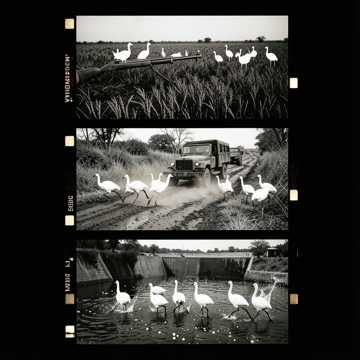

Emu War

Meme Wikipedia · 3:52

Mock-Heroic Military March, Aussie Bush Ballad, Vaudeville Comedy, Oompah Brass, Snare Rolls, Banjo

Lyrics

[Intro] Ladies and gentlemen, it's nineteen thirty-two! The army's going to battle, and the enemy is... *checks notes*... birds. Boom boom boom, the emus said hello! [Verse 1] The war was done, the vets got land out in the Western Aussie dirt, They planted wheat, the prices crashed, and everybody's wallet hurt, Then twenty thousand emus came and ate up every single crop, They kicked the fences open and the rabbits joined the party, nonstop! So the farmers told the Minister, "We've seen machine guns do their thing," And the Minister said, "Sure, it's target practice," with a thumbs-up and a grin! [Chorus] Oh, the emus won the war! The emus won the war! The army brought ten thousand rounds, the birds were like, "What for?" The soldiers had the Lewis guns, the emus had the legs, And nobody in Campion got to scramble any eggs! (Boom boom!) The emus won the war! [Verse 2] It rained for weeks, the birds dispersed, the major had to wait, Then on November second he rolled up to the gate, They tried to herd them to an ambush, but the emus split in squads, They ran in tiny zigzag groups like feathered little gods! A thousand emus marched up to a dam to have a drink, The gunners waited, opened fire, and the gun jammed. Clink, clink, clink! They only got a dozen, and the rest just strolled away, And not another bird was seen for the remainder of the day! [Chorus] Oh, the emus won the war! The emus won the war! The army brought ten thousand rounds, the birds were like, "What for?" The soldiers had the Lewis guns, the emus had the legs, And nobody in Campion got to scramble any eggs! (Boom boom!) The emus won the war! [Bridge] So the major strapped a gun onto the back of a truck! But the road was way too bumpy, and the gunner had no luck! Each squad had got a leader who was six feet tall and black, He stood on watch while all his homies ate the wheat and came right back! (Guerrilla tactics! Guerrilla tactics!) The major said, "They're tanks, mate, the bullets just bounce off!" And somebody in Parliament asked, "Are we giving them a medal?" (Cough, cough.) [Verse 3] The report said no one died, except the soldiers' dignity, So they packed up all their guns and left in total misery! But then they came back for round two and claimed a perfect score, Nine hundred eighty-six dead birds and ten bullets each, not one more! The historians are saying that those numbers are a stretch, And the emus kept on eating wheat and playing endless fetch! [Final Chorus] Oh, the emus won the war! The emus won the war! The army brought ten thousand rounds, the birds were like, "What for?" The soldiers had the Lewis guns, the emus had the legs, And nobody in Campion got to scramble any eggs! They asked for troops again in thirty-four and forty-three, The government said, "Absolutely not, go build a fence for free!" (Boom boom!) The emus won the war! [Outro] So if you're bringing guns to fight a bird that's six feet tall, You'd better build a fence instead, or you won't win at all. Boom boom boom... the emus won. (The emus always win.)

Tardigrade

Cute Wikipedia · 3:32

Twee Children's Pop, Wide-Eyed Whimsy, Bouncy 120 BPM, Ukulele, Glockenspiel, Toy Piano, Pizzicato Strings

Lyrics

[Intro] Hey, come over here and look into my microscope with me, Because there's a tiny friend in here that I really want you to see! [Happy Verse] In seventeen seventy-three, a German man looked down, And he saw a chubby little creature slowly crawling around. He called it "little water bear," and the cutest name was born, And people call them moss piglets now, and they wear them on their shirts with pride. Three years later an Italian said they're "slow walkers," and it's true, Because they wobble on eight stubby legs the way a sleepy bear would do. [Upbeat Chorus] Oh, the water bear is tougher than anything you know, And it's only half a millimeter, but it's ready for the show! It can freeze, it can bake, and it can float in outer space, And it still comes home a-wiggling with a smile upon its face! So when your day is feeling heavy and you're wondering what to do, Just remember the little water bear is hanging on for you! [Happy Verse] They're living in the moss and lichen growing on your garden wall, And there could be two million in a square meter, if you count them all! They climb on mountaintops, and they paddle in the deepest sea, And they're cozy in the rainforest and in the Antarctic breeze. Every little leg has tiny claws that help them hold on tight, So they never slip or slide away when they're walking day and night. [Upbeat Chorus] Oh, the water bear is tougher than anything you know, And it's only half a millimeter, but it's ready for the show! It can freeze, it can bake, and it can float in outer space, And it still comes home a-wiggling with a smile upon its face! [Bridge] When the puddle dries up, it doesn't panic or cry; It tucks its legs in like a little ball and takes a nap till by and by. They call that curl a "tun," and it can sleep for years that way, Through the coldest cold and hottest heat, until a rainy day. In two thousand seven, water bears rode up on a rocket ship, And they spent ten days in the vacuum on a little outer space trip! They've got a special protein that protects them like a hug, So the sunshine and the radiation can't hurt our snuggly bug. [Happy Verse] Their great-great-grandparents were wiggling half a billion years ago, And they've lived through five big extinctions, so they've got a lot to show. The mommies lay their tiny eggs, and in two weeks they hatch, And the babies poke their way outside to start a brand-new batch. If you find a dried-up water bear, just add a drop of rain, And you'll watch your sleepy little buddy start to dance again! [Upbeat Chorus] Oh, the water bear is tougher than anything you know, And it's only half a millimeter, but it's ready for the show! It can freeze, it can bake, and it can float in outer space, And it still comes home a-wiggling with a smile upon its face! So I'll knit you one in yarn, and I'll get you one that's plush, Because a water bear's a friend who never needs to rush! [Outro] They say our planet really belongs to the water bears, And I think that's pretty lovely, because they're proof that someone cares. So hold on tight like tiny claws do, and don't you ever quit, Because a love that's like a water bear will never break one bit.

Antikythera mechanism

Spoken Wikipedia · 4:01

Cinematic Spoken Word Boom Bap, Awed Reverence, 88 BPM, Clockwork Tick Percussion, Lyre Samples, Deep Sub Bass

Lyrics

[Intro] [Spoken Word] In nineteen-oh-one, the sponge divers dropped down To a Roman cargo ship that the ocean had drowned. [Spoken Verse] They were forty-five meters deep off a Greek island's coast, And they hauled up marble men and the bronze that mattered most. They brought up coins and jewels and glass that gleamed, But the greatest treasure there was not what it seemed. It looked like a lump of rock that the salt water chewed, So the museum let it lie while the statues were glued. For two long years it sat there and nobody knew, Until two cousins looked closer and saw a gear poking through. [Chorus] This is a computer that was built before Christ. It was cranked by a hand, and it counted the skies. It was cast out of bronze, and it sank in the sea, And it waited two thousand years for someone to see. [Spoken Verse] Now listen to the numbers, because numbers don't lie. The biggest gear held two hundred twenty-three teeth, and that defies Every textbook that told us the ancients were slow, Because two-twenty-three is the Saros, and so When the months roll around in that eighteen-year spin, The shadows line up and the eclipses begin. The glyphs on the spiral spelled Selene and Helios, And they named the day and the hour when the darkness would cross. [Rapped Verse] You turn the crank, and the cosmos turns with you. The Sun drives the Moon, and the Moon rides through A pin in a slot where two gears sit off-center, So the Moon rushes close and it lingers in winter. They modeled the motion that Kepler would explain, And they did it with bronze and a hand-cut chain. A little ball spins, and it's half black and half white, And it shows you the phase that the Moon wears at night. The Metonic dial marks two hundred thirty-five months, Which is nineteen solar years, and it squares them at once. One pointer runs backward, and it counts out the Games: Olympia, Nemea, Isthmia, Pythia by name. [Chorus] This is a computer that was built before Christ. It was cranked by a hand, and it counted the skies. It was cast out of bronze, and it sank in the sea, And it waited two thousand years for someone to see. [Bridge] [Spoken Word] But I have to tell the truth, and the truth cuts deep: The teeth were filed by hand, and the triangles slipped. The Mars pointer wandered thirty-eight degrees wrong, Because the theory was weak while the wheels were strong. The design was a genius that the bronze couldn't hold, And it may never have worked the way the story gets told. [Spoken Verse] And here is what haunts me, and here is what stings: Nobody builds perfection first, so there were older things. Cicero wrote that Archimedes built a turning sphere, And a Roman general carried it home when Syracuse fell that year. But bronze was worth money, so the masterpieces melted, And the knowledge went down like a ship when it's pelted. For fifteen hundred years, no one built one again, Until clockmakers in Europe caught up with these men. [Outro] So when they tell you the past was a primitive place, Remember they carried the cosmos inside a wooden case. They held the whole sky in a box made of wood, And they understood heaven better than we thought they could.

From arXiv, in the Informative style

Made by Paper Songs, which runs this recipe on the top Hugging Face papers every morning.

Nerdy Power-Pop, Wry Didactic Wit, Rapid Patter Talk-Singing, Driving 132 BPM, Jangly 12-String, Wurlitzer, Handclaps, Gang-Vocal Chorus, Crisp Dry Mix

Lyrics

[Intro] Is on-policy learning really better, or is that just a story we've been told? Let's run a fair experiment and find out which of the claims will hold! [Verse 1] People say on-policy training helps a model forget much less, And they say it makes the updates sparse and generalizes best. But the studies pitting SFT against RL changed a dozen things at once, So nobody could isolate what the rollout policy had done. [Verse 2] This paper uses strong-to-weak distillation as a cleaner test, Where a big teacher trains a little student while they freeze the rest. In OffPD the student studies answers that the teacher wrote, In OnPD the student writes, and the teacher scores it token by token. They crossed each rollout policy with the forward and the reverse KL, At one times ten to the minus five, and at five times that as well. An eight-billion teacher taught a one-billion student, three seeds each, On medicine, science, and Countdown math, a hundred fifty steps to teach. [Chorus] The rollout policy is not the star of the show! The KL direction decides how high the scores will go, And the learning rate decides how much the student will forget, So on-policy is not automatically your safest bet! [Verse 3] The best accuracy hit seventy-two for on and seventy-three for off, While forward KL scored seventy-one to seventy-three, no matter what. Reverse KL swung from thirty-five to seventy-two percent, And it rose and fell with learning rate wherever it went. At the low rate, forgetting moved one point three points at most, But at the high rate, eleven to fourteen points of skill were lost. Sparsity ran eighty-five to ninety when the rate was low, But fifty-two to sixty when they made the rate grow. [Chorus] [Bridge] They slid the rollouts on a spectrum that they labeled lambda, From teacher-favoured on the left to student-favoured on the right. Forward KL stayed above eighty percent, it moved just five point two, Because its gradient is bounded and it covers every mode it knew. Reverse KL is mode-seeking, and its log-ratio can explode, So it does its best when the student walks along its own road. [Verse 4] On harder Countdown with four numbers, on-policy finally shone, With pass-at-k ten to fifteen points higher than off-policy had shown. But after three hundred steps of RLVR, the off-policy runs climbed highest, So that early edge did not survive when reinforcement tried it. Forward KL gave bigger pass-at-ten gains from sampling more, And when the teacher spoke in Spanish, most students copied it for sure, But OnPD with reverse KL kept the student speaking English, Because it matched the teacher's English mode and left the Spanish. [Verse 5] They removed the gradient clipping, and they tried a sampled KL, They trained on longer math of six hundred twenty-two tokens as well, And the story stayed the same: forward KL is the steady one, And the learning rate still governs what forgetting will be done. [Outro] On-policy needs fresh generation all the way through training, While off-policy reuses data, so the savings keep on gaining. So test OffPD as your baseline before you pay the higher price, Because the objective and the learning rate may matter twice!

Motorik Krautrock-Electronica, Patient Hypnotic Focus, 118 BPM, Pulsing Analog Sequencer, Tape-Echo Guitar, Deadpan Sung-Spoken Vocals, Swelling Choir Chorus

Lyrics

[Intro] A video never pauses while the model is thinking, So a streaming assistant has to watch and remember at once. This is the story of a model called OneStreamer, And it learned to record, to wait, and then to answer. [Verse 1] Real video arrives as an open-ended stream, And the model can't know which moment will matter later. A detail that looks unimportant at the start Can become the key to a question asked a minute after. By then the frames have left the model's little window, But the answer still depends on what it saw. If you keep every frame, the memory starts to crowd out the present, And if you keep only recent frames, the past is simply gone. [Chorus] So write it down, write it down, while the evidence is new. OneStreamer turns what it sees into notes it can reuse. It keeps sixteen recent frames, and the captions hold the rest, And it waits until the proof is there before it answers your request. [Verse 2] The memory is called Proactive Hierarchical Caption Memory, And the paper shortens that to PHCM. An Observe token opens a caption of local detail, Which covers the objects, the actions, and the changes in the scene. A Summary token wraps up an event once it's complete, So the notes form a hierarchy from fine detail to big picture. Every note is tied to the time when it happened, And no old visual features ever need to be revisited. [Verse 3] For proactive questions there are three states to choose from. Silence means "keep watching," and Standby means "it's coming." Response means the evidence is finally enough to answer. But silence fills the training data, and it drowns the rare decisions. So Proactive State Transition Learning, which the paper calls PSTL, Keeps the loss on every output anchor And samples the moments where a state changes or holds steady. It supervises only 27.5 percent of the state tokens, And it still beats dense supervision on every proactive test. [Chorus] [Verse 4] To train it, the team built a pipeline for streaming data, And it releases each caption only after its evidence appears. Response times were calibrated to the earliest reliable second, Which moved the answers 13.72 seconds earlier on average. Combined with cleaned open data, this formed OneStreamer-1M, A dataset that holds more than a million records across many tasks. [Bridge] The model has only 4 billion parameters, Yet it ranked first on all 8 streaming benchmarks it was tested on. It improved 25 percent over its base model on average, And it beat the strongest rival on each test by 6.1 percent. It scored 72.1 on OVOBench and 86.9 on real-time StreamingBench. When the model kept its captions, backward recall rose from 63.5 to 71.6, And its real-time perception got better instead of worse. Compared with keeping the full history, the context shrank by more than nine-tenths, GPU memory dropped by about 60 percent, And the time to the first answer fell from four and a half seconds to about one-eighth of a second. [Outro] So proactive generation becomes one shared skill, Because it links seeing, remembering, and speaking at the moment it's needed. When someone asks where the kids can go to read, It remembers the small yellow table upstairs.

Jazz-Rap Boom Bap, Confident Scholarly Swagger, 92 BPM, Upright Bass, Vibraphone, Dusty Sampled Drums, Muted Trumpet, Crisp Rhythmic Flow, Soul Choir Hook

Lyrics

[Intro] Let me teach you how to train an agent that can do real work. The paper calls the method GraphForge, and it starts with real files. [Verse 1] A working agent reads the files and coordinates the tools, And then it builds a deliverable that other people use. To train one, you need tasks that sit on many real-world files, And every result has to be something you can check. One older pipeline let a model invent the files itself, So the workspaces felt fake and the variety ran thin. Another pipeline used real files but wrote no rubric down, So nobody could verify that the finished work was right. [Chorus] GraphForge builds an evidence graph across the files, And the task and the rubric are compiled from that graph. Every requirement is backed by a file inside the workspace, And every criterion is anchored to the files that prove it true! [Verse 2] The seeds are drawn from O*NET, which lists the jobs that people do. After filtering, it keeps 246 occupations in sixteen sectors, And it covers 891 detailed task types. Seeds are chosen by coverage, so the common jobs don't take over. A search agent finds a public case and downloads the real files, And every file is given a hidden role the agent never sees. Core files drive the math, and supporting files give context. Confusers look plausible but don't apply, and ambient files add clutter. [Verse 3] A node records a source file and the fact that it provides, And an edge records the way that two files depend on each other. The agent only sees the task and files, but the judge receives the anchors. A teacher model runs each task once to test that it's doable, Then a revision agent repairs the task against the original files. A trajectory is admitted only when it scores above 0.90. That leaves 2,169 trajectories, and they're long. They average fifty steps and a hundred sixty-two thousand tokens. [Chorus] [Verse 4] They fine-tuned a twenty-seven-billion-parameter open model. On GDPVal its Elo rose to 1445.7, which is up 65.7. Workspace-Bench-Lite climbed to 63.7, which is up 7.7, And SpreadsheetBench II jumped to 24.0, which is up 13.7! A thirty-five-billion-parameter model gained 101.7 Elo, And the gains held up in every agent scaffold that they tried. [Bridge] Then they ran rejection fine-tuning on four rollouts per query. The rubric picked the best one if it scored above 0.95, And those 462 examples improved all three benchmarks again. Random picking was the weakest arm, so selection matters. They checked 39,201 training files against GDPVal's 260, And not a single file was shared between the two. On tasks from jobs the training never covered, it won 73.9 percent. When a cited worksheet was deleted, the judge's score dropped 0.377, But the judge still missed tiny edits to rows, numbers, and citations. [Outro] So this is why it matters for the agents yet to come. When a task is built from evidence, the evidence can grade it. The data and the models are released for everyone, So the next agents can learn to work faithfully on real files.

How it works

From page to song in four steps

There's no Article Song server. The add-on runs in your browser and calls the AI services with your own keys.

  1. Read

    Mozilla's Readability pulls the article out of the page, skipping menus, ads and cookie banners. Highlight a passage to sing just that part. PDFs work too.

  2. Write

    Claude reads the article and writes lyrics in the style you picked: verses, a chorus, a bridge, built from the article's actual facts.

  3. Arrange

    Claude reads its own lyrics and picks a genre, mood, tempo and instruments to fit, so a story about emus gets an oompah band.

  4. Sing

    Suno, through SunoAPI.org, records the song. It starts playing in your browser as soon as the first audio streams in.

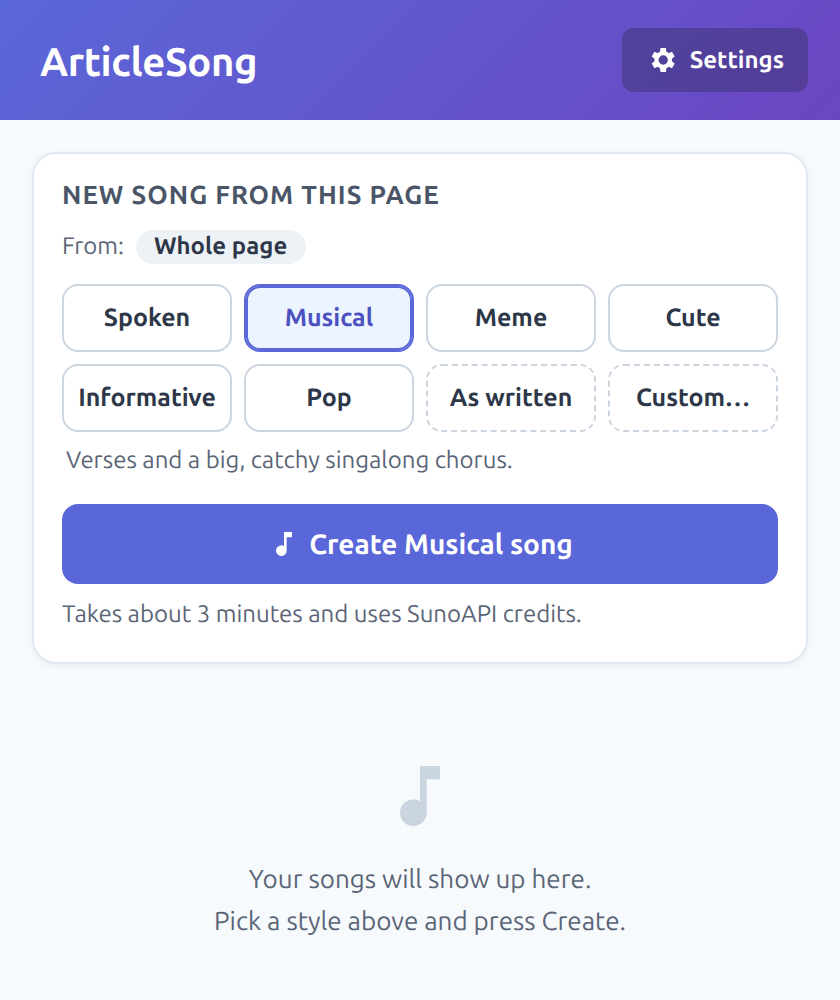
The popup with eight style buttons and a Create button
Pick a style. Choosing one never spends credits; nothing happens until you press Create.
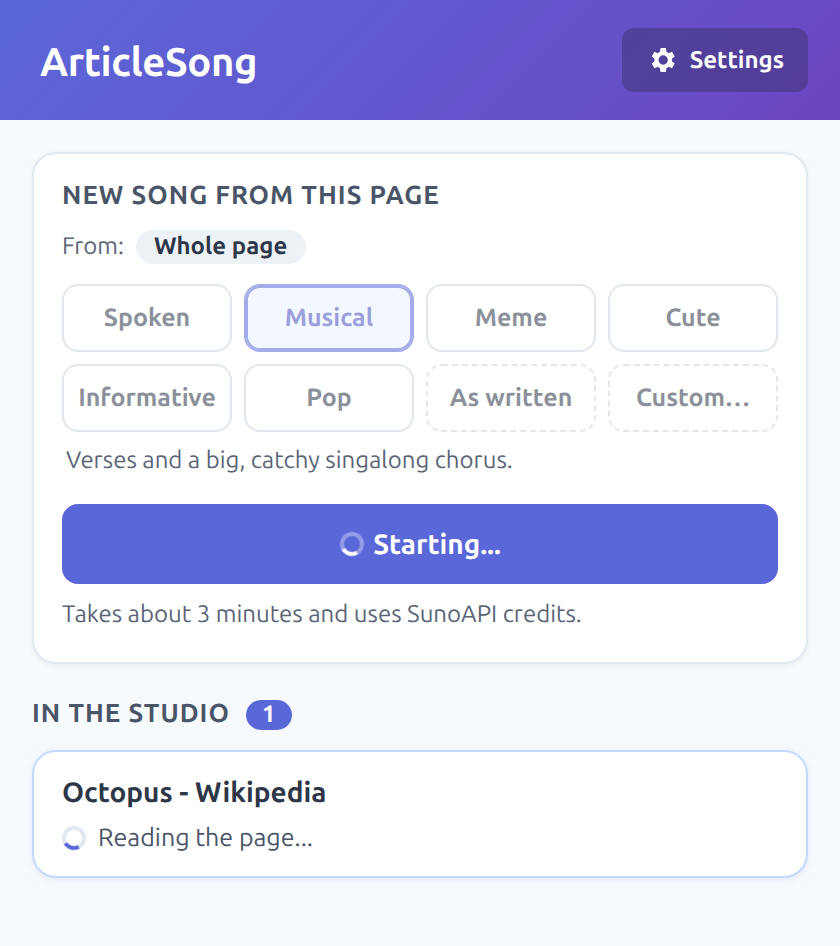
The popup showing a song in the studio, reading the page
Watch it get made. Each song moves through Read, Lyrics and Music with the time left. Queue up as many as you like.
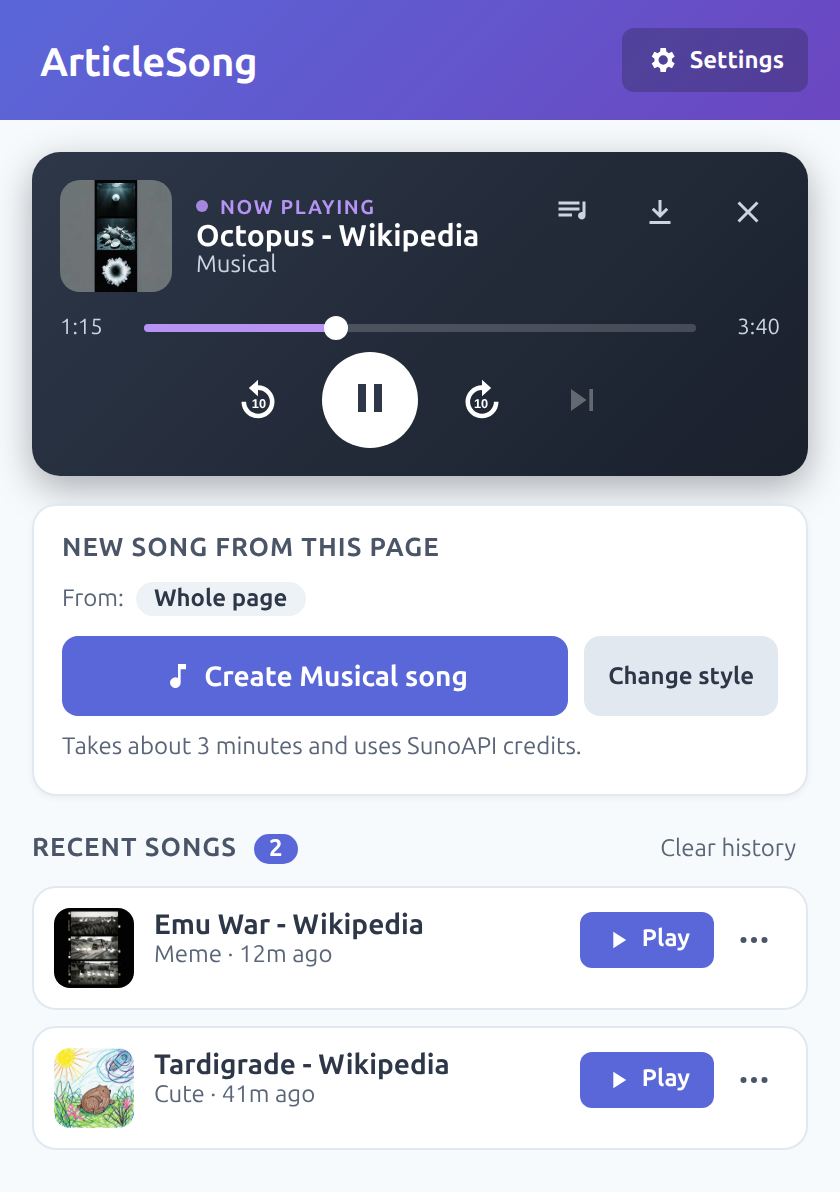
The popup's player with the current song and two recent songs
Listen. Skip around, read the lyrics along with it, download the MP3, or replay anything from your recent songs.

Styles

Eight ways to sing it

Each style is a different brief to the lyricist. You can rename the six presets and rewrite their instructions in Settings.

MusicalVerses and a big, catchy singalong chorus.
SpokenRhythmic spoken word, where the words matter more than the melody.
MemeSilly, catchy and very online.
CuteLight, warm and upbeat. Makes you smile.
InformativePacks in as many of the article's facts as it can. Good for studying.
PopHooks first. Radio-friendly and repetitive on purpose.
As writtenSings the article's own words, with no rewriting at all.
Custom…Describe any style you want: a sea shanty, a lullaby, a power ballad.

Get started

Set up in about two minutes

  1. Add Article Song to Firefox from Mozilla's add-on store.
  2. Get a SunoAPI key at sunoapi.org. This is the one required piece: it's a paid service, and each song uses a few cents of credits.
  3. Paste the key into the popup the first time you open it. The popup walks you through it.
  4. Optional: add an Anthropic key in Settings, from console.anthropic.com. With it, Claude writes the lyrics and picks the music style, which is how every song on this page was made. Without it, SunoAPI writes the lyrics instead, which costs less but sticks less closely to the article.
Your data. The add-on has no server and collects nothing. Your keys stay in your browser. When you press Create, the article goes to SunoAPI (and to Anthropic, if you added a key) and nowhere else. Privacy policy.
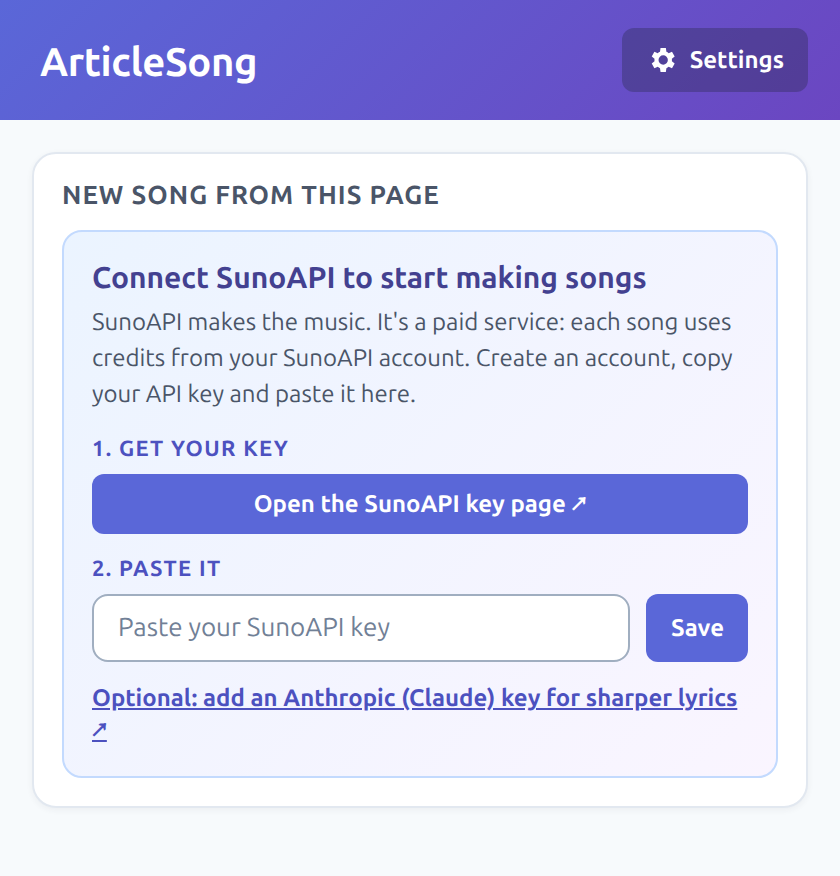
The popup's first-run screen asking for a SunoAPI key
First run. One key and you're making songs.

Find out what your reading sounds like

Free and open source. Bring your own keys.