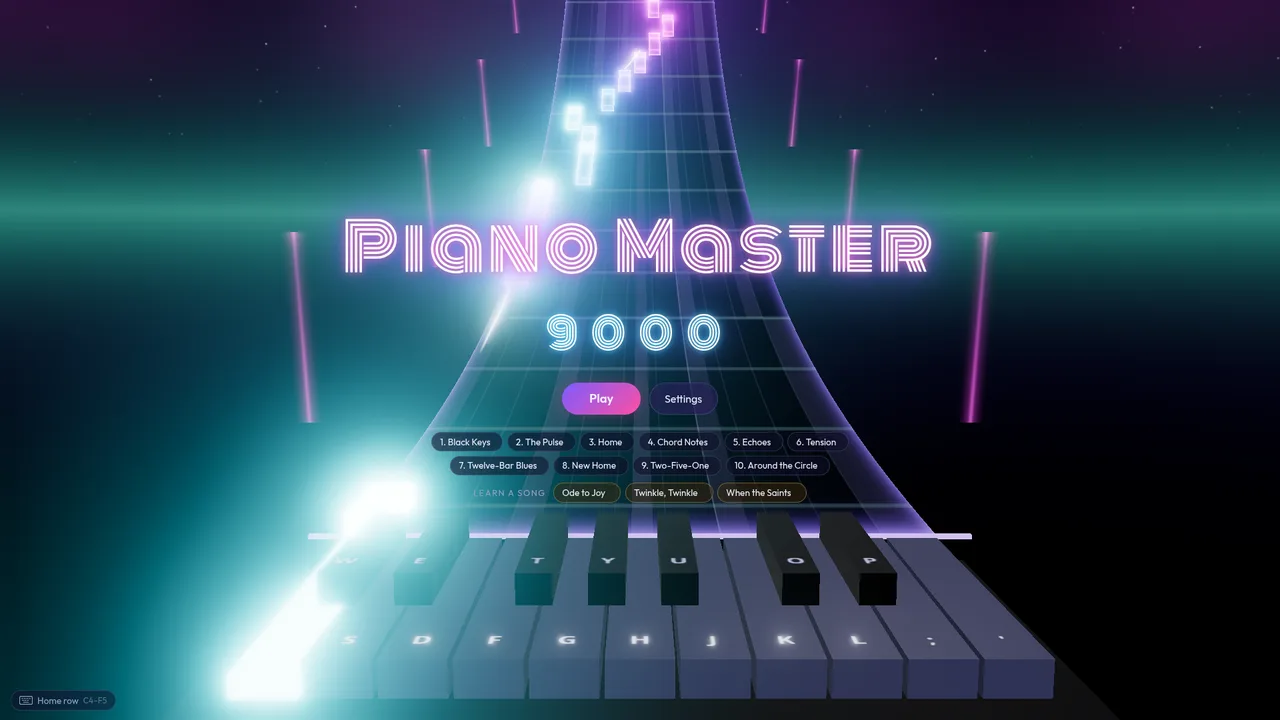
Piano Master9000
Play whatever you like. The notes fly away.
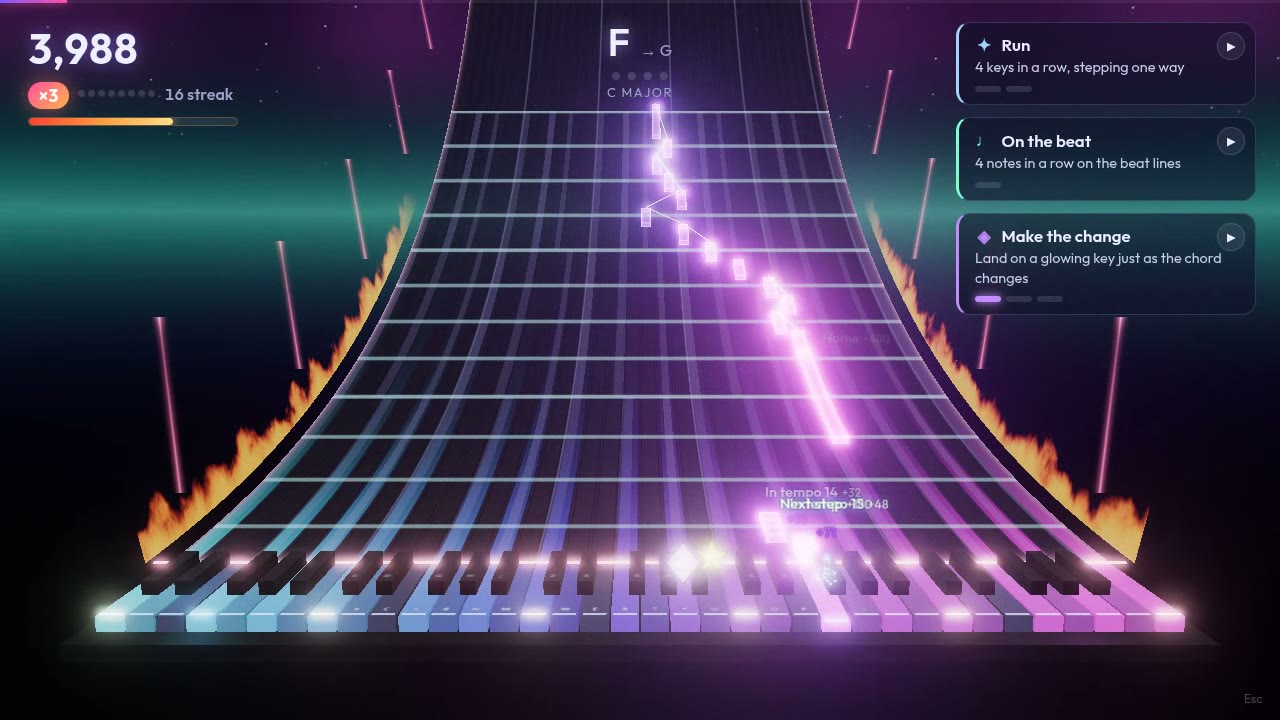
An improvisation game. Nothing rushes at you. You play, and your notes sail off up a neon road behind the piano. Goal cards from music theory decide what scores: a run up the scale, notes on the beat, landing on the chord as it changes, a tense note released, a phrase that ends at home. Every note that fits earns a little, so play what sounds good to you.
How it plays
- Four levels of help. Before a jam, pick how much it shows and says. First steps keeps to the white keys, deals one card at a time, and when you pause names one thing you did, the first time in a sentence that says why. Learning follows your key and lights the chord's notes softly. Jamming adds chord names, the tempo and two cards. Showing off is everything at once.
- Jam!, and the game listens. Press Jam! and play anything. After a few notes the metronome finds your beat and keeps time with you, speeding up and slowing down as you do. Each note you play leaves a dot on its swing, and it glows when you're in time. Play an idea again and it pops up as a little staff, with up to three good things about it: a leap that steps back, a rhythm of its own, a note pushed off the beat, tension that resolves, a hook, landing home. A plain run up the scale gets none, and each good thing pays. The keys outside your key fade back, home gets a gold stripe, and every key shows its note name under its laptop letter. Stop, and it holds a couple of bars, then fades out and waits for you. The notes you play fly away from the keys, so what you just played is laid out behind the piano like a score.
- Teach. The title's other big button: 33 short lessons in six chapters, for someone who has never improvised. Each one says one thing. The game plays a little idea on a staff and a lit keyboard, you play it back, then you make up your own that does the same thing. First steps: echo, land on home, long and short, question and answer, a leap then a step, calm and busy, loud and soft. The beat: on it, rests, off it, short and smooth, swing. Grow an idea: say it again, climb the ladder, the same rhythm with new notes, upside down. Chords: play one, major and minor, three chords, pop's four, twelve bars. Modes: the same white keys with a new home, each with its one special note (Aeolian, Dorian, Mixolydian, Lydian, Phrygian), then Ode to Joy in the dungeon. Game music: the Mario cadence, the minor iv, and a minor tune that ends major. Every lesson is scored with the jam's points: playing it cleanly earns two stars, and three take something more, the good things the game hears in your own ideas.
- A band that follows you. Once the metronome has your beat, the band comes in a part at a time: bass and pad, then drums, then everything. It picks its chords from what you play, in your key, then settles into a loop and plays it round and round, so you can learn the changes: two chords for beginners, four as you go up, and a new chord every bar at Showing off. Change key, or play notes that clearly want other chords, and it finds a new loop. It plays below your hands and leaves you room when you're busy. A lane at the top shows the chord playing now, with its keys, and slides in the chords coming up, so you can see a change before it arrives. Beside the road the band's players light up as they play: the drums and cymbals on every hit, the bass string with its note, and the chord on the keys.
- Trading phrases. Play a phrase and stop, and the game answers it with a variation on a vibraphone, while the notes show as sheet music with a bar sweeping across them in time. Then it's your turn: Play this! Each note fills in as you play it.
- Grades as you play. Tiles down the left of the jam grade ten parts of your playing from S to F: the beat (how close your notes land, in milliseconds), the key, fitting the band's chords (the tile shows the band's chord as gold keys), rhythm, tension and release, phrasing, the shape of your melody, playing an idea again and changing it, mixing it up (short and long notes, slow and fast, low and high, soft and loud; after each phrase it calls out what you changed, like “Higher” or “Shorter”), and loud and soft on a MIDI keyboard. Phrases in a row that each switch something start a switch-up chain worth double, then triple. Each tile shows what you're doing now with a small picture, and the end of the jam gives you a report card with the one to work on. In Settings you can turn the grades off, or turn the cards off and play to the grades alone.
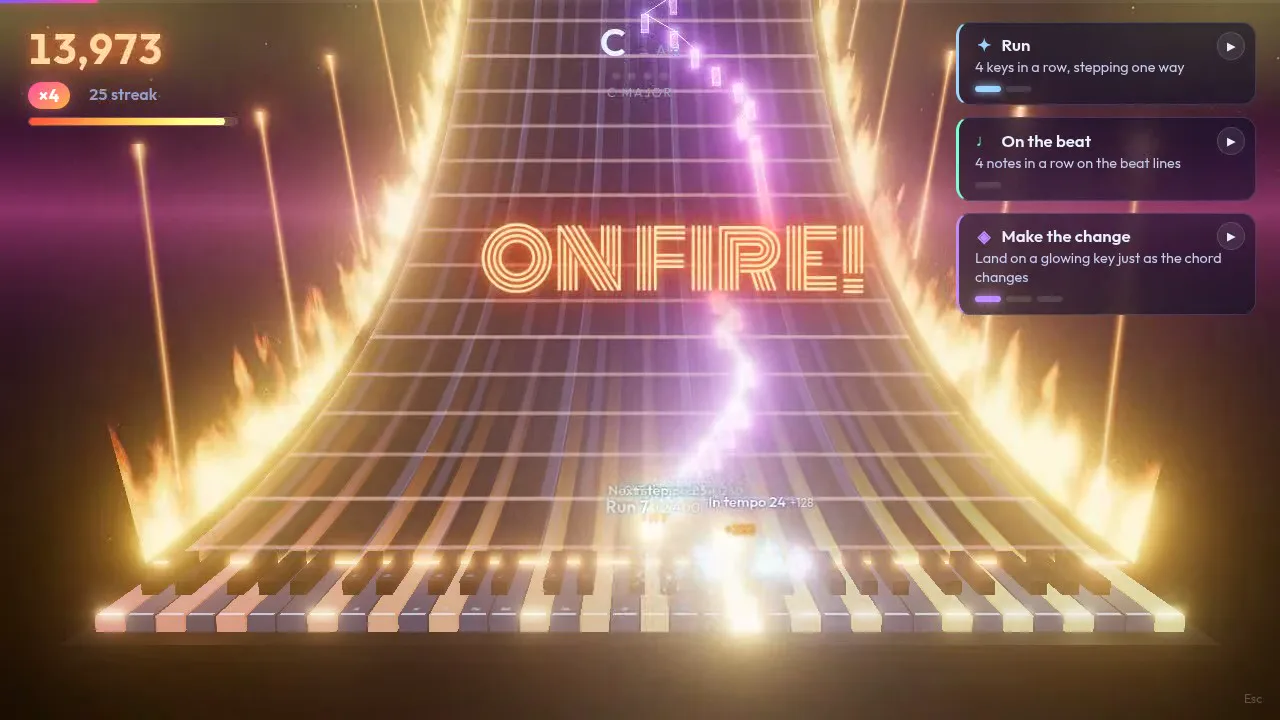
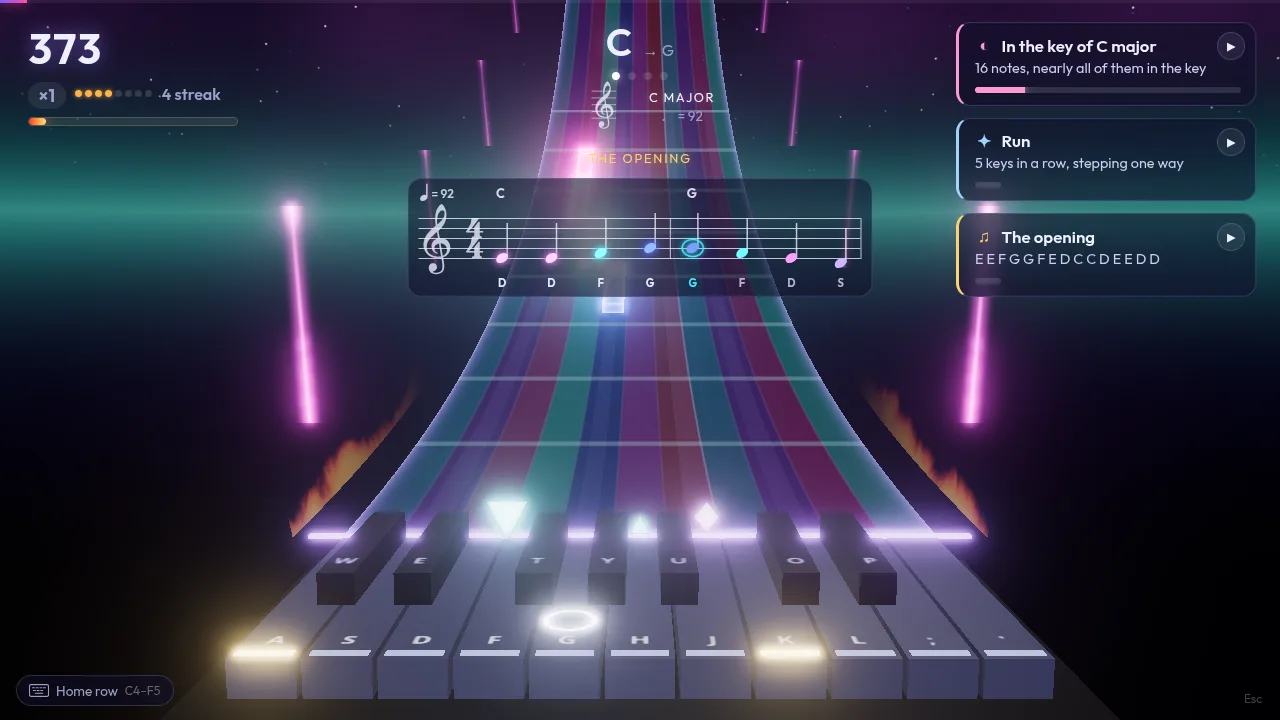
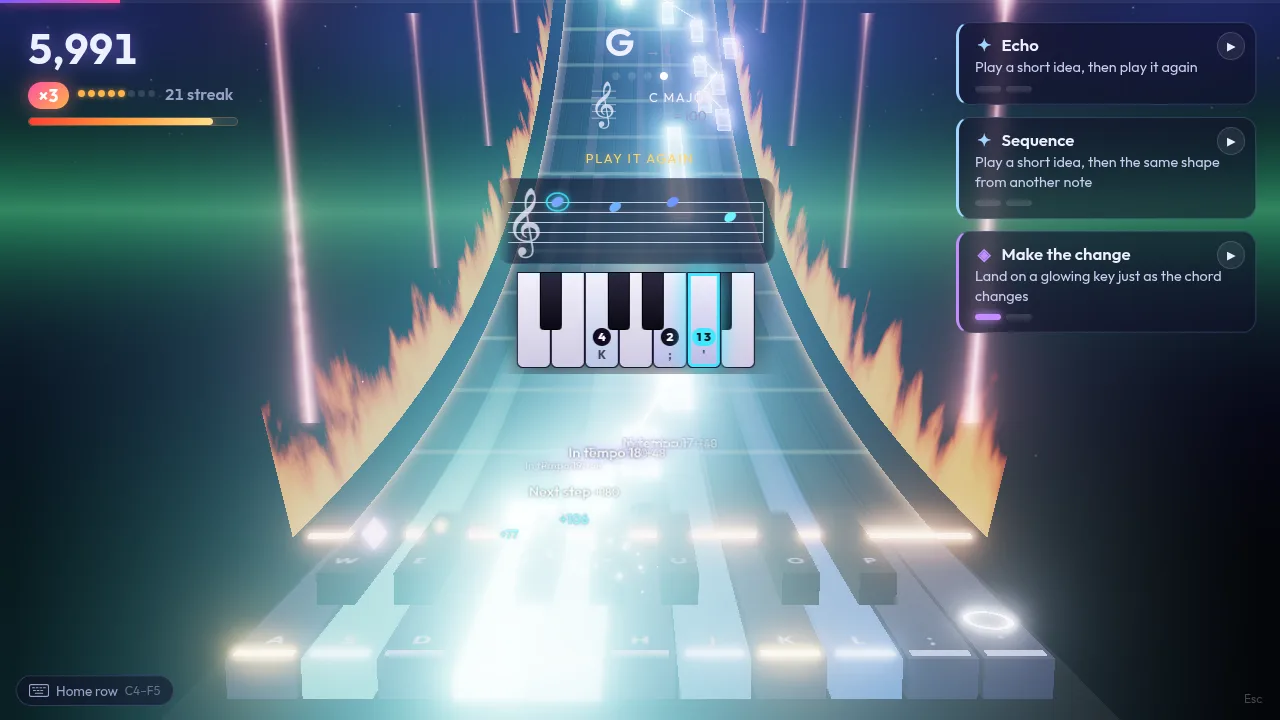
- The cards say what scores. Goal cards sit on the right: one at a time for beginners, up to three at Showing off. A move pays only while a card asks for it. New cards ask for your last idea's rhythm with new notes, your idea upside down, a pickup into the bar, a note pushed ahead of the chord, triplets, a mode's special note, and the note a borrowed chord brings. When you finish a card it bursts into points and the next one slides in. Each card has a ▶ that plays an example.
- Hints on the keys, a few at a time. The keys carry one pointer at a time for beginners (the next note to play, or home), more as you go up. At Showing off, one to three icons hover over keys near your hand, jumping about as you play: a note of the chord, the coming chord's guide tone, the next step of the scale, home, a spicy extra note. Follow them or don't; playing one pays a little.
- Every note shows its job. A note in the chord blooms as it lands, and a colourful extra note sparkles. A note from outside the key trembles and pulls a thread toward the key that would settle it. Play that key and the thread snaps and the note glows; leave it and the note greys out.
- Each kind of card brings its own help. The six kinds are listed below. The help shows only while that kind of card is out.
- Streaks and fire, from Jamming up. (Turn them on or off in Settings.) Fitting notes in a row build a streak that lifts the multiplier to ×4, and every note flies its points up off its key. Good playing fills a fire meter. Flames lick up along the keys as it fills, and when it tops out you're on fire for eight bars of double points.
- Everything gets noticed. The game watches for runs, turns, trills, neighbour notes, harmonies, downbeats, a phrase that climbs and comes back down, loud after soft, busy after calm, and more, and pays a little for each. A move that a card asks for pays far more. Play an idea three times and it goes on your shelf; then try it higher, lower, or with one note changed.
- The stage plays along. Light pillars line the road and pulse with the drums: a kick rolls up the road as a wave of light. Lasers sweep the sky when the chords change. A crowd cheers you on. You can turn it down in Settings.
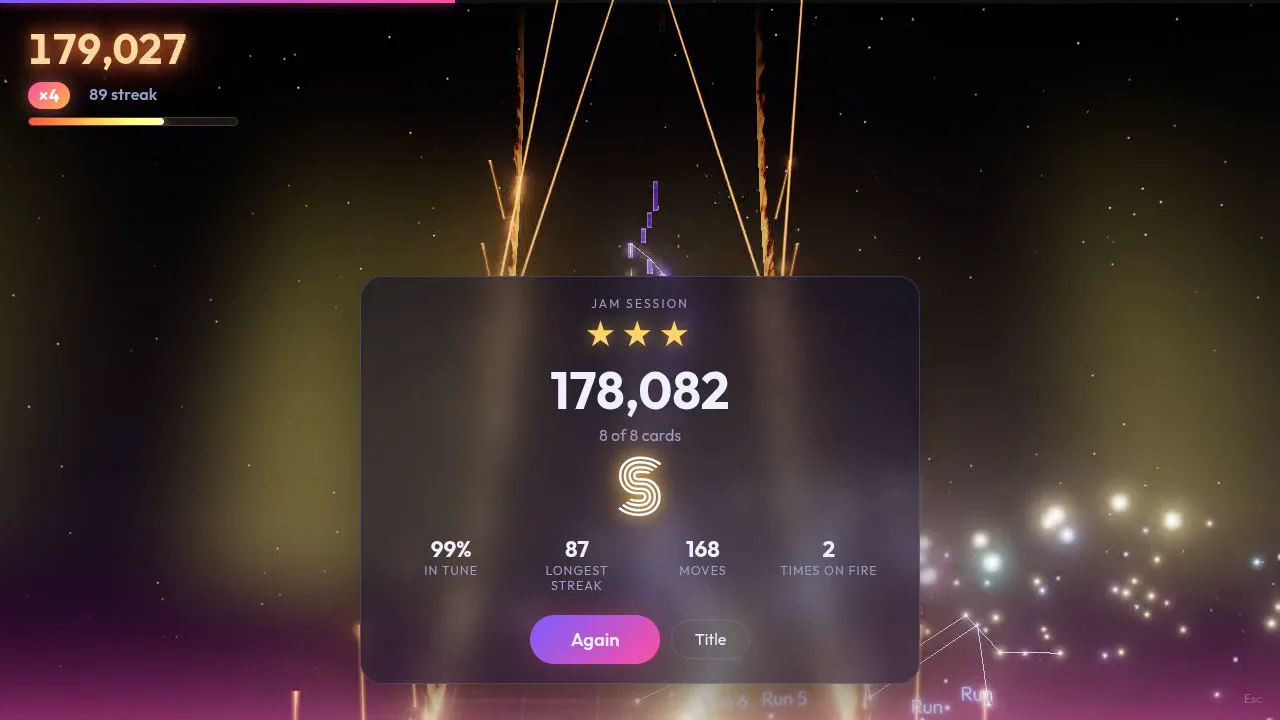
- Your notes become the sky. Every note that reaches the end of the road rises and settles as a star, and the shapes you finish become constellations. When the song ends, you look up at the sky you played.
- The levels' band, if you want one. The levels and songs keep a metronome; turn their band on in Settings and it plays the level's own groove and chords. As your multiplier climbs it plays busier and brighter, and it goes all out while you're on fire.
Six kinds of goal
Runs, arpeggios, a motif repeated or moved. A motif to play shows above the road on a staff and on a little keyboard, its keys numbered in order with your laptop letter on each, and a phrase you just played appears there so you can echo it. The scale's keys light up, and a run's next step gets an arrow. The notes that made the shape join up into a constellation.
On the beat, between the beats, swing, leaving space, or a tempo a card sets (the metronome moves to it). The beat lines brighten and flash where you land.
Land on the chord as it changes. The chord's own notes glow on the keyboard and run as lanes along the floor. The next chord's keys glow faintly just before it arrives.
Play a note from outside the key, then release it. A red ring and a taut thread show the note it wants to fall to.
End a phrase on the key's home note, and let it ring. A gold halo marks home.
Stay in the key, follow the chords to a new one, or move where a card asks (it names the notes that change). Notes take the colours of the circle of fifths, and the key is one band of colour.
Playing on a laptop
Home row
The default, as in GarageBand. The middle row of letters is the white keys and the row above it the black keys: A–' and W E T Y U O P on QWERTY: eleven white keys, and the piano on screen is just as wide. Keys go by position, so Dvorak and AZERTY work too.
Two rows
Z–M are the white keys of the low octave and Q–U the high one. The rows above them are the black keys.
Scale keys
Every key plays a note of the scale and each row is an octave higher, so there are no wrong notes.
Learn a song
Ode to Joy, Twinkle, Twinkle and When the Saints. The metronome keeps the song's tempo and the cards walk you in: its key, its notes, its tempo, each phrase, then the whole tune. A phrase shows as sheet music, four bars at a time with the song's chords above it, each note coloured like its key and labelled with your laptop letter. The notes fill in as you play them, with a ring on the next key. Slips are fine.
Levels
Start with the Jam Session, which follows you and deals one card of each kind. The levels follow a path from scales to jazz. Each one teaches one new kind of card and mixes in the ones before.
- 1Black KeysThe five black keys make a scale where nothing clashes. Runs and long notes.
- 2The PulseDrums come in: land on the beat, then between the beats, then leave space.
- 3HomeThe white keys are C major, and C is home. End a phrase there.
- 4Chord NotesThe chord's notes glow. Land on one just as it changes, or skip between them.
- 5EchoesA motif said twice, then moved to start on another note. Work in the level's motif.
- 6TensionNotes from outside the key, released into the key next door.
- 7Twelve-Bar BluesA shuffle, blue notes flicked into their neighbours, and swing.
- 8Minor HomeThe white keys with A as home: A minor (Aeolian), sad and epic. Its special note is F.
- 9New HomeD as home: D Dorian over a modal vamp, minor but cool. Its special note is B.
- 10Laid BackG as home: G Mixolydian, major but bluesy. Its special note is F.
- 11FloatingF as home: F Lydian, dreamy, like flying in a film. Its special note is B.
- 12DangerE as home: E Phrygian, dark and threatening. Its special note is F, falling to E.
- 13Game MusicChords borrowed from outside the key: the bittersweet F minor, and A♭, B♭, C, the level-clear fanfare. Play the black key each one brings.
- 14Two-Five-OneDm7, G7, Cmaj7. Guide tones and approach notes, with a swing.
- 15Around the CircleEvery four bars the key moves a step round the circle of fifths, all the way to F♯. Find each new note.
Pictures